How do the Makah Whale?
Historic Makah Whale Hunting
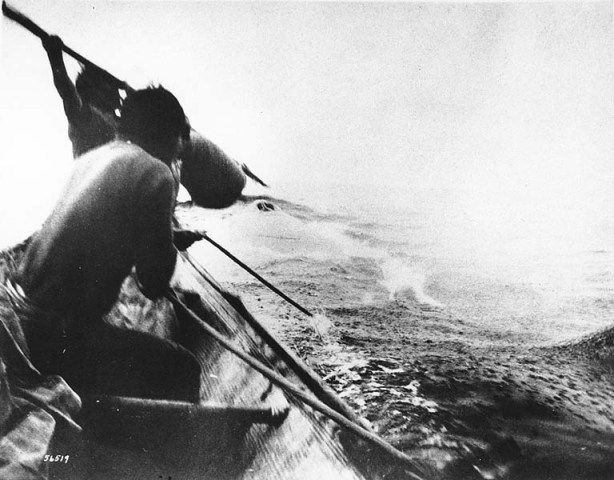
The Makah Indians have whaled for centuries, traditionally off the coast of Neah Bay in the pacific ocean, in the northwest corner of the USA in Washington state. Below is some information about how they whale, and there will be links.
To get ready for the hunt, whalers went off by themselves to pray, fast and bathe ceremonially. Each man had his own place, followed his own ritual, and sought his own power. Weeks or months went into this special preparation beginning in winter and whalers devoted their whole lives to spiritual readiness.
Men waited for favorable weather and ocean conditions and then paddled out, eight in a canoe. They timed their departure so that they would arrive on the whaling grounds at daybreak.
Paddling silently, whalers studied the breathing pattern of their prey. They knew from experience what to expect. As the whale finished spouting and returned underwater, the leader of the hunt directed the crew to where it would next surface. There the men waited.
When the whale rose, the paddlers held the canoe just to its left, their speed matched to the animal's. As the back broke the surface, the harpooner struck and the crew instantly paddled backward, putting all possible distance between the canoe and the wounded prey so as to avoid the thrashing tail flukes. A hit in the shoulder blade interfered with use of the flippers and slowed the whale. Floats of sealskin blown up like huge balloons and attached to the harpoon line slowed the whale. Harpoons weren't intended to kill the whale, but to secure the sealskin floats to them until they tired themselves and could be lanced fatally.
Shafts of yew wood measured 12 to 18 feet long - heavy wood to add to the harpooner's thrust and help the blade pierce deeply. Splices in the shaft deadened the springiness and furthered the penetration. They also let the shaft break rather than hit the canoe repeatedly if the whale rolled. Furthermore, they allowed a clean break rather than a splintering. This aided repair.
Shafts fell away once the harpoon head had been set. In a whale, the head turned partly sideways. Barbs of elk antler helped to keep it from pulling out. They fit one on each side of the blade, which was mussel shell. Spruce pitch - at Ozette still pungent after 500 years within the earth - fared and smoothed the head. Whale sinew plied into rope and bound with wild cherry bark attached the harpoon head to as much as 40 fathoms of additional rope. This line, which was of twisted cedar boughs, was carried coiled within the baskets so that it would play out easily and wouldn't entangle the canoe's occupants.
A telltale float at the end of the line acted as a marker so that the whalers could follow their prey, setting additional harpoons and staying out over night if need be. Eventually the time came for the final kill which was done using a special lance.
The next step was to tow the whale home - a distance of only a few miles if its spirit had heeded prayers to swim for the beach, perhaps 10 miles or more if not. As a precaution against the whale's sinking, a diver generally laced the mouth shut. This kept water from flooding into the stomach, weighing the carcass down and complicating the tow.
Songs eased the paddling. Songs welcomed the whale to the village; welcomed the returning hunters and praised the power that made it all possible.
The relationship between Makah and whales is very old. Ozette deposits dating from 2,000 years ago hold humpback and gray whale bones and barbs from harpoons. The relationship is also very recent. The Makah Tribe resumed whale hunting under international and domestic law, and on May 17, 1999, harvested their first whale in 70 years.
Modern Makah Whaling
In 1855, the Makah Tribe entered into a treaty with the United States wherein they ceded title to thousands of acres of land in exchange for the federal government's protection of their ancient whaling traditions. The Treaty of Neah Bay is the only treaty with such a clause explicitly written into it.
On May 17, 1999 the Makah conducted the first successful whale hunt in more than 70 years. The Makah were forced to cease whaling practices in the 1920s due to the scarcity of gray whales caused by the commercial whaling industry.
The resumption of whaling had a profound effect on life in this small reservation. Suddenly Neah Bay was the focus of attention from around the world. Reporters from all over the Northwest were sent to Neah Bay to cover this historic event, and the controversy surrounding it.
Animal rights activists opposed the hunt. The border of the reservation was constantly guarded and clashes between protestors and the Makah were common in the weeks leading up to the hunt.
Despite all the opposition, the whaling crew continued to practice the skills they needed to ensure their safety and a successful hunt. None had ever hunted quarry so large and they all knew the world was watching.
There were, however, certain regulations set forth by the International Whaling Commission which deviated from the traditional methods of Makah whalers in the past. Whereas the traditional hunt involves using only harpoon strikes and a final strike with a special "killing lance", the new method required a quicker and thus, more humane kill. Working with a veterinarian, the Makah used both a traditional harpooner and a rifleman. The rifleman uses a specially designed large caliber rifle which, soon after the harpoon hits its mark, delivers the fatal blow. None of the spiritual, physical, and mental preparations needed to harvest a whale are interrupted by the substitution and implementation of this technique.
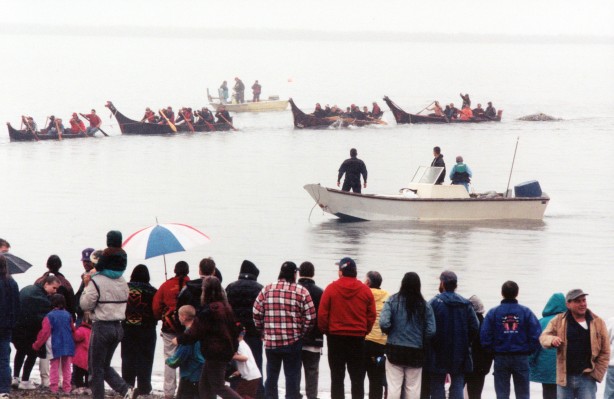
On the Morning of May 17, 1999, Makah whalers accomplished what they had prepared and trained months for. That morning, as the news of the successful hunt spread, the village of Neah Bay assembled on the beach to welcome the whale to the community as their ancestors did more than 70 years ago.
Canoes from many surrounding villages came to assist the Makah in delivering the quarry to the people. As the whale was towed to shore, the people ran into the water to have a closer look. With eyes wide, they touched the smooth skin and examined it's mottled pattern. Children were amazed at the size of the creature.
The whale was then prayed over, as were the whalers. Prayers were offered to thank the whale for giving its life to sustain that of the Makah and to free its spirit for passage to the other side.
After proper respect was paid, the whalers began carving and distributing the meat and blubber to the people to taste for the first time what had been a staple for their ancestors for thousands of years. The whale was butchered through the night and the meat and blubber was either frozen, smoked or stewed.
Later that week, Neah Bay was host to the largest celebration in its history. American Indians from all over the U.S. and Canada and indigenous people from all over the world came to celebrate the Makah's return to whaling. The Neah Bay High School Gym was filled to capacity with people from all over the world who came to sample the catch and news media from all over the country covered this historic event.
Two years ago, a US federal appeals court acknowledged the tribe's treaty right to whale. However, the court ruled that the tribe must comply with the US Marine Mammal Protection Act and obtain a waiver before it can proceed with a hunt. The Tribe applied for a waiver in February 2005. Currently, the US government is reviewing the Tribe's request in an Environmental Impact Statement and will begin a formal rule-making process.
Once the Makah is granted a waiver, their hunts would be conducted with a domestic permit as it was during the successful hunt in 1999. The Tribe shares a gray whale quota with the natives of Chukotka, Russia Federation issued by the International Whaling Commission.